Now Reading: Accuracy in food forest education | Vector Group
-
01
Accuracy in food forest education | Vector Group
Accuracy in food forest education | Vector Group
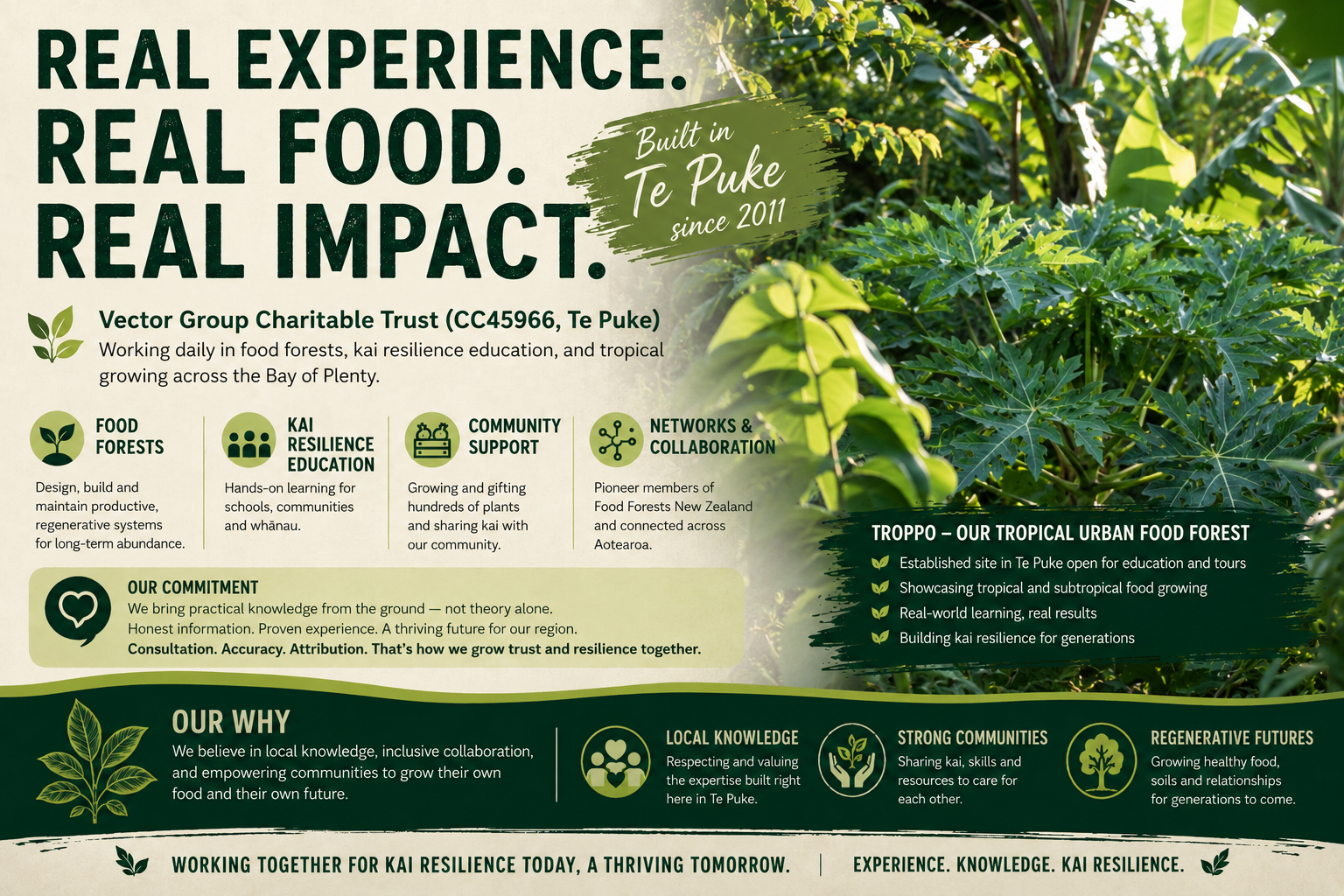
Vector Group Charitable Trust (CC45966, Te Puke) works daily in food forests, kai resilience education, and tropical growing across the Bay of Plenty. When public bodies publish growing advice without consulting practitioners who built the work locally, accuracy and attribution both matter. This is our response — from experience on the ground, not from theory alone.
On 4 October 2024, Mana Kai Mana Ora published Food Forests and Syntropic Agroforestry (author: Amy Board). The piece promotes regional hui, workshops, and community food forests — goals we share. Several statements in it are misleading, unsourced, or published without the editorial care readers deserve from a network presenting itself as a Western Bay authority on kai resilience.
Our wider concern is documented separately: Vector Group was not consulted on the MKMO plan (PDF, June 2024), is absent from the Mana Kai Mana Ora about page narrative, and was not invited into the Regional Kai Resilience Network process — despite operating Troppo, gifting 50,000+ plants since 2011, and pioneering community food access from pre-2000 roots through Daisy’s Inc, Godfuel, and Vector Group Holdings — with Te Puke delivery from 2011. This article is one example of that pattern: Te Puke expertise is referenced, but not the organisation that established it.
Accuracy matters
Regenerative growing already faces scepticism. When influential networks publish unchecked claims, those claims spread through Facebook groups, workshops, council papers, and funding bids until they read as fact. Practitioners who have spent years trialling systems — including failures — deserve better.
Good intentions matter. Good information is essential.
“Also known as food forests” — a core confusion
The article opens:
Syntropic agroforestry, also known as food forests, is much more than a low-maintenance way to grow food that mimics natural forest ecosystems.
From our perspective as growers: syntropic agroforestry and food forests are related but not the same thing.
- Syntropic agroforestry (Ernst Götsch, Brazil) is succession-based: dense planting, stratification, biomass cycles, pruning, and active disturbance management.
- Food forests (permaculture / forest gardening traditions) are often designed and managed differently — layered polycultures, guilds, and varied stewardship intensity.
Conflating the two confuses newcomers, schools, and funders. At Troppo we teach both the overlap and the distinction — because Te Puke growers ask for clarity, not slogans.
Indigenous stewardship — a serious claim without sources
The same paragraph states:
…this method is deeply informed by the land stewardship practices of Brazil’s Indigenous peoples, who have cultivated the land in harmony with nature for centuries.
Indigenous peoples worldwide have shaped ecological knowledge for millennia. That is not in dispute. What is in dispute is publishing a direct lineage claim for syntropic agroforestry without citations, iwi engagement, or references to Götsch’s own published methodology (which centres succession ecology and system observation).
Public educators carry responsibility — especially when the same network’s regional plan was not developed with consultation of long-standing Te Puke practitioners.
“Hundreds of years” and “three to four hundred years” — quoted, but not challenged
The article quotes Byron Austin (Byron Grows, Whakatāne):
“This isn’t a sprint; it’s a marathon. These systems will produce food for hundreds of years. We’ll be planting trees that will bear fruit for three to four hundred years. This is just the start of something incredible.”
MKMO reproduced these lines without qualification. Readers will reasonably treat them as endorsed network messaging.
Our practical view:
- Food forests and syntropic systems can be long-term — with succession planning, replanting, pest and disease management, climate adaptation, and ongoing human stewardship.
- Most productive fruit trees common in Bay of Plenty food forests — citrus, avocado, stone fruit, tamarillo, feijoa, bananas, and many subtropicals — have productive lifespans measured in decades, not centuries.
- Inspiring language is fine in conversation. Educational publishing should distinguish inspiration from horticultural fact.
At Troppo we welcome visitors who want real timelines: what fruits in year three, what fails in a wet winter, what needs replacing after a cyclone season. That honesty builds trust. Century-scale promises do not.
“One of the most mature food forests in Aotearoa”
The article directs readers to PermaDynamics as:
To learn about one of the most mature food forests in Aotearoa, check out PermaDynamics.
PermaDynamics is a respected demonstration site. Saying it is “one of the most mature” nationally requires defined criteria and comparison — otherwise it is opinion presented as fact.
Aotearoa has many long-running food forests, community orchards, mara kai, and tropical collections. Vector Group’s own Troppo tropical urban food forest in Te Puke — documented for years, toured through Food Forest Tours, connected to Food Forests New Zealand — is not mentioned in the article at all.
Te Puke is named only via workshop providers:
Experts like Jim / Nearsy from Mount Maunganui and Kris Edgington from Te Puke are also offering workshops…
No reference to Vector Group’s established site, our plant gifting programme (50,000+ plants since 2011 — around 5,000 a year), how we donated hundreds of plants to Kris, alternative education kai work, or KaiResilience.food — infrastructure the regional network does not cross-link on its public channels.
Regional hui promotion — inclusion matters
The piece promotes the Regional Kai Resilience Network Hui (Ōmanawa food forest tour, Humanitix registration). Vector Group was not part of the planning visible to us, despite:
- an operational food forest open for education;
- COVID-era food distribution networks;
- a published pioneer record in Te Puke;
- a direct contact from Amy Board to visit our site — a visit that has not yet occurred (as recorded in our partnership files).
Promoting “connection” and “sharing knowledge” in a regional article while omitting the charity that built much of Te Puke’s practical kai infrastructure is not collaboration. It is erasure by omission.
What we contribute to the public record
Practical knowledge in this rohe does not begin with a 2024 blog post. It includes:
- Vector Group — pre-2000 roots through Daisy’s Inc, Godfuel, and Vector Group Holdings; Te Puke since 2011; community fridge, pātaka kai, kiwifruit bins, youth kai education, 50,000+ plants gifted since 2011
- Troppo — tropical urban food forest, Te Puke
- Grow Te Puke · Crop Swap Te Puke · https://nurserymap.troppo.nz
- kiwifruit.capital — regional food and community resilience storytelling
- Networks of growers across Tauranga, Te Puke, and the Bay — including PermaDynamics and many others worth citing fairly
We are not asking MKMO to agree with everything we do. We ask them to fact-check educational claims, separate syntropic and food-forest terminology, source cultural statements properly, and consult practitioners before defining who leads kai resilience in Te Puke.
Our invitation
If Mana Kai Mana Ora, COLAB, or the Regional Kai Resilience Network want accuracy and collaboration:
- Correct or annotate the 4 October 2024 article where it overstates outcomes or conflates terms.
- Visit Troppo and document Te Puke’s operational food forest in your regional materials.
- Include Vector Group in future hui, plans, and cross-links — or explain publicly why a pioneer charity with kai roots before 2000 is excluded from the Kawenata and planning table.
Explore our work: Kai resilience · Our lineage — Owen Takuira-Ngaropo & The Rock · Contact