Now Reading: Our application for the Te Puke Community Ideas Forum
-
01
Our application for the Te Puke Community Ideas Forum
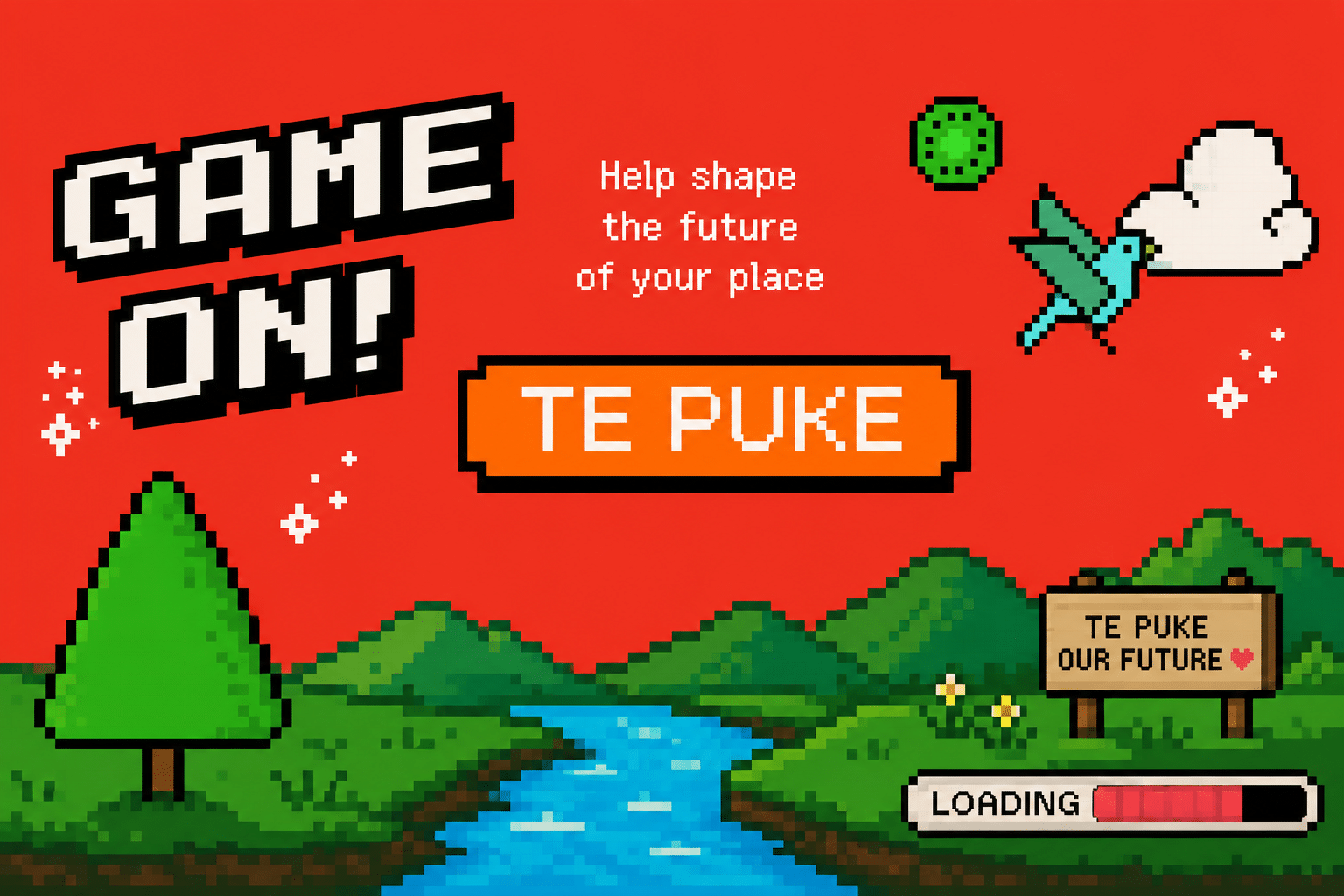
Our application for the Te Puke Community Ideas Forum
Our submission below:
I would like to join the Te Puke Community Ideas Forum because Te Puke’s next 30–50 years should be shaped by people who have been doing the mahi on the ground — not only by plans written after the fact. I have lived and worked in Te Puke for many years as a volunteer trustee of Vector Group Charitable Trust (CC45966). Our charitable work — youth mentoring, kai resilience, community directories, emergency housing support, and practical growing education — is publicly documented and open to verification. I am applying in a personal capacity, with that lived experience behind me.

The spatial plan topics Council names — housing, transport, community facilities, business areas, open spaces, and the natural environment — sit directly in work I already help deliver locally. Troppo is an operational urban food forest in Te Puke. We have a filed community food forest proposal seeking a council land pathway. Through Te Puke Digital and Kiwifruit.Capital we maintain regional visibility infrastructure that helps residents, visitors, and organisations find each other. Through the Bay of Plenty Volunteer Network we connect people to practical community participation. These are not abstract interests. They are long-running programmes that show how Te Puke already grows, connects, and cares for its people — and what infrastructure a growing town will need if that community layer is to keep carrying pressure that rates-funded services cannot stretch to alone.
In June 2026 I submitted constructively to Council on Annual Plan engagement design — asking, among other things, that organisations already delivering in Te Puke be mapped and invited before consultation windows close, and that filed proposals receive follow-up. Council’s reply acknowledged the submission, noted the formal Annual Plan period had closed, and fairly observed that Te Puke no longer had a local newspaper insert during that cycle. I appreciated that honesty. I also noted Council’s commitment to strengthen how key stakeholders are identified — which is exactly why this forum matters now.
There is an understandable tension in the messaging: Council invites a diverse range of people to help ensure the community’s voice is front and centre, while also noting that spaces are limited and applications will be independently assessed. I do not read that as bad faith. I read it as a design choice — and I am applying because I hope the assessment process genuinely includes operators and long-standing contributors, not only familiar institutional voices. Te Puke’s spatial future needs people who can challenge assumptions with evidence, respectfully disagree where plans overlook existing community assets, and explain what residents are already building without waiting for permission. That is the contribution I want to make.
I understand the forum is not a decision-making body. Council’s own messaging is clear: the role is to test ideas, surface local priorities, and help planners understand what matters here. That is enough for me. Meaningful influence in local government often comes from being in the room early — when draft spatial choices about where growth goes, what open space is protected, and how community facilities are placed can still be shaped. I would rather contribute inside a structured process than comment only after drafts are fixed.
If selected, I would bring particular focus to:
• Open space and natural environment — community food forests, urban growing, and edible landscapes as resilience infrastructure, not optional amenity.
• Community facilities — how volunteer-led programmes, youth pathways, and connector infrastructure complement formal facilities.
• Housing and social pressure — what grassroots organisations see before it appears in reports: affordability stress, temporary housing need, and isolation.
• Business areas and regional identity — how Te Puke’s horticultural and visitor economy connects to local visibility, employment pathways, and town centre vitality.
• Engagement design — how Council reaches people who deliver unpaid outcomes but are not on standard mailing lists.
I am available for both sessions on Wednesday 7 October and Wednesday 14 October, 6pm–8pm.
I care about Te Puke’s future as a place where community-led work is recognised, where filed ideas receive a fair hearing, and where long-term planning honours what is already growing here. I am not seeking funding, endorsement, or a platform for grievance. I am seeking a constructive seat at a table Council says it wants to widen — to help ensure the Te Puke Spatial Plan reflects the town as people who live and work here actually experience it.
Ngā mihi,
Stephen Fawcett
Te Puke / Maketū–Te Puke Ward
Trustee, Vector Group Charitable Trust
027 414 4280 · [email protected]
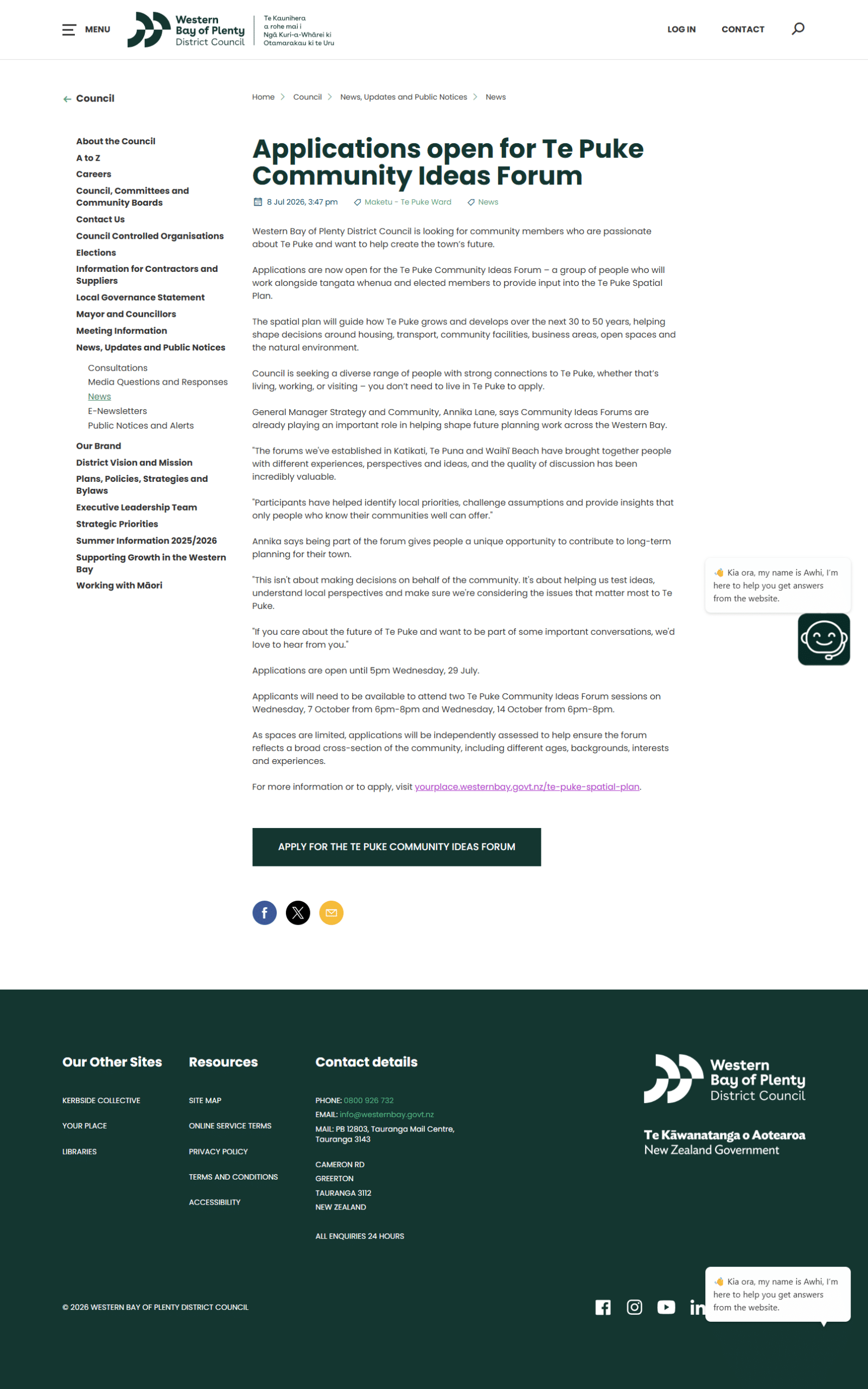
Looking at both the media release and the application page together, there are several governance and public participation considerations. Some are strengths, while others raise legitimate questions about the process.
https://www.westernbay.govt.nz/council/news-and-updates/news?item=id:2ys71l8f71cxby83b30e
https://yourplace.westernbay.govt.nz/te-puke-spatial-plan
Positive aspects
The process aims to:
- Include community members, tangata whenua and elected members.
- Seek a broad mix of ages, backgrounds, interests and experiences.
- Bring local knowledge into long-term planning.
- Use an independent selection process rather than first-in-first-served.
- Provide a later public consultation for those not selected.
These are all common features of deliberative engagement processes.
Areas that deserve scrutiny
1. “Community voice is front and centre”
Council says:
“We’re creating a Te Puke Community Ideas Forum to help us ensure the community’s voice is front and centre…”
Yet participation is by invitation after an assessment process.
This means the “community voice” is actually a selected subset of the community, not the community as a whole.
That is not necessarily wrong, but the wording may give the impression that the forum broadly represents the community when it is, by design, curated.
2. Selection criteria are largely undefined
Council explains the outcome:
“…a broad cross-section…”
but not the methodology.
Questions include:
- What criteria are scored?
- Who performs the independent assessment?
- What qualifications do they have?
- How is unconscious bias managed?
- Can applicants request reasons if unsuccessful?
- Is there any appeal or review?
Without transparency, trust depends largely on confidence in the assessors.
3. “Challenge assumptions”
Council repeatedly says participants will:
challenge assumptions.
A key governance question is whether applicants who have previously challenged Council policies, planning decisions or governance are genuinely viewed as valuable contributors—or whether “challenging assumptions” is interpreted only within acceptable boundaries.
A truly deliberative forum benefits from constructive dissent, not just diversity in demographics.
4. Representation versus selection
The forum is intended to reflect:
- ages
- backgrounds
- interests
- experiences
These are valuable dimensions.
However, representation can also include:
- business owners
- community organisations
- volunteers
- disability advocates
- environmental groups
- youth
- older residents
- renters
- homeowners
- Māori
- Pacific communities
- newcomers
- long-term residents
- people who have previously engaged with Council
- people who have criticised Council processes
It is unclear how these forms of representation are balanced.
5. Later consultation is not equivalent
Council notes that unsuccessful applicants can participate in public consultation in 2027.
However, this is different from participating in the forum itself.
The forum helps shape the draft before wider consultation begins. By the time public consultation occurs, the framework, assumptions and options may already be well developed.
So there is a practical distinction between:
- helping create the draft, and
- commenting on an existing draft.
6. Independence
Council repeatedly refers to an “independent selection process.”
Good governance would usually involve publishing:
- who the independent party is;
- how independence is ensured;
- whether they have any relationship with Council;
- how conflicts of interest are managed.
Simply stating a process is independent does not, by itself, demonstrate independence.
Overall reflection
Taken together, the process appears to follow a recognised deliberative engagement model: a smaller, selected forum followed by broader public consultation. That approach can work well when it is transparent and genuinely representative.
The main governance questions are not about whether Council should have a forum—they reasonably can—but whether the selection process is sufficiently transparent to justify claims that the forum represents the community and will “challenge assumptions.”
The credibility of the forum will depend less on the stated intention than on whether Council can demonstrate that the selection process is open, fair, independent, and inclusive of a genuine diversity of viewpoints, including voices that may be critical of Council’s existing approaches.