Now Reading: Learn Kai Resilience Online with Food Resilience School NZ
-
01
Learn Kai Resilience Online with Food Resilience School NZ

Learn Kai Resilience Online with Food Resilience School NZ
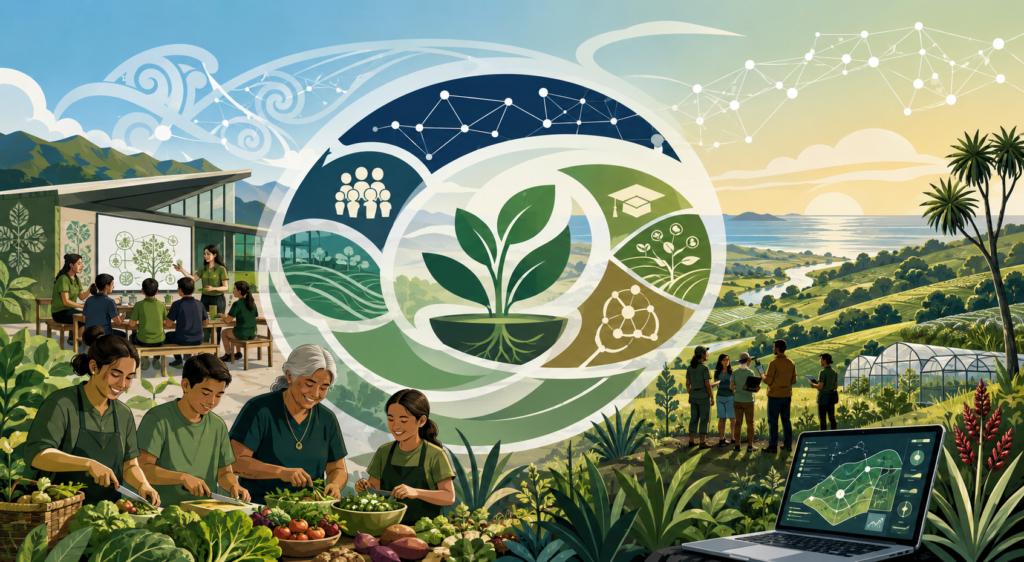
We have recently soft-launched Food Resilience School:
https://foodresilience.school.nz/
This platform forms part of our broader kai resilience work in Te Puke, across the Bay of Plenty, and nationally through our wider resilience initiatives:
- Te Puke Kai Resilience: https://www.vectorgroup.org.nz/our-work/kai-resilience/
- National Kai Resilience Network: https://www.kairesilience.food/
Context
Due to a lack of meaningful consultation, exclusion from key collaborative discussions, limited local funding support, and ongoing situations where individuals have sought recognition or funding for work they did not create, we have published several public statements outlining our position and documenting the history of our involvement:
- Kai Resilience, Collaboration & Inclusion: https://www.vectorgroup.org.nz/kai-resilience/kai-resilience-collaboration-inclusion-vector-group/
- Kai Resilience Record: https://www.vectorgroup.org.nz/kai-resilience-record/
- Accuracy in Food Forest Education: https://www.vectorgroup.org.nz/kai-resilience/accuracy-in-food-forest-education-vector-group/
For additional context, the Mana Kai Mana Ora plan can be viewed here: you will notice we are excluded ;-(
https://manakaimanaora.nz/wp-content/uploads/2024/06/mkmo-plan.pdf
Built From Real-World Practice
All course material, systems, content, photography, and learning resources have been developed from our own operational experience, including our food forest, nursery, community gardens, resilience projects, and educational programmes.
The foundation courses currently available are intentionally very basic. They have been designed to support complete beginners and provide an accessible entry point into food growing, resilience, and community learning.
Purpose-Built Learning Platform
The platform has been custom-built by me from the ground up. While it shares some similarities with platforms such as Skool, it has been specifically designed for kai resilience, food system education, community engagement, and grower-led course delivery.
Features include:
- Course creation tools for growers, educators, and community groups.
- Network-wide event publishing, allowing events to be automatically distributed across participating sites.
- SCORM-compatible learning modules for more professional and technical training.
- Mentoring, coaching, and guided learning pathways.
- Community engagement and participation tracking.
Privacy & Impact Reporting
Anonymised learning and engagement data is securely aggregated into OSVector AI, a charity-owned reporting system that I developed to support impact measurement and programme evaluation.
This reporting includes metrics such as:
- Course participation
- Learning engagement
- Volunteer contribution
- Time invested
- Mentoring activity
- Programme outcomes
No personal information is transferred into reporting systems.
Mentoring, Probation & Personal Growth
The platform also supports specialised mentoring programmes.
For example, individuals completing court-ordered community service can undertake meaningful learning and mentoring experiences while fulfilling their required hours.
Rather than simply recording attendance, participants can receive:
- Probation completion reports
- Personal growth assessments
- Achievement certificates
- CV-building documentation
- Mentoring references
This creates opportunities for genuine personal development, confidence building, and future employment pathways.
Part of a Much Larger Ecosystem
Food Resilience School is only one component of a much larger ecosystem that we have developed over the past several years.
Our national kai resilience network at:
https://www.kairesilience.food/
is currently undergoing a significant overhaul and expansion.
Looking Ahead
One of the projects I am most excited about is RegenOS:
Currently in closed beta, RegenOS has emerged directly from years of practical experience, identifying gaps across food forestry, resilience planning, community development, education, impact reporting, and regenerative systems design.
The vision is ambitious, and I genuinely believe it has the potential to transform how food forest practitioners, community groups, growers, educators, and resilience-focused organisations collaborate, learn, measure impact, and create lasting change.
There is still a lot to build, but the journey so far has been incredibly rewarding, and I’m excited to share more as these systems continue to evolve.
Kai Resilience — https://www.kairesilience.food/
Kai Resilience — School hub — https://www.kairesilience.food/school/
Kai Resilience — Tools hub — https://www.kairesilience.food/tools/
Food Forests NZ — https://foodforests.nz/
Food Forests resource hub — https://foodforests.co.nz/
Food Resilience School NZ — https://foodresilience.school.nz/
(alias: school.kairesilience.food)
Grow Te Puke — https://www.growtepuke.com/
Troppo (urban food forest + brand)
Troppo — https://www.troppo.nz/
Companion Planting Matrix — https://companionplantingmatrix.troppo.nz/
Garden / Troppo Quiz — https://quiz.troppo.nz/
3D Canopy Visualiser — https://3d-canopy-layer-visualisation-tool.troppo.nz/
Orchard Planner — https://orchardplanner.troppo.nz/
Continuous Harvests — https://continuousharvests.troppo.nz/
RegenOS — https://regenos.app/ (land / food-forest planning)
RootyToot — https://rootytoot.app/ (community network — in development)
Vector Group Charitable Trust — https://www.vectorgroup.org.nz/ (CC45966)
Kai Resilience — FB page + group (growing)
Food Forests NZ — FB page + group
Troppo — instagram.com/troppo.nz · facebook.com/troppo.nz